Why would three towns with comparable schools, similar commute distances to Manhattan, and nearly identical household incomes sell homes for prices that differ by close to a million dollars? That is the puzzle sitting underneath every Wilton listing right now, and it is not the puzzle most buyers think it is.
The Gap, In Plain Numbers
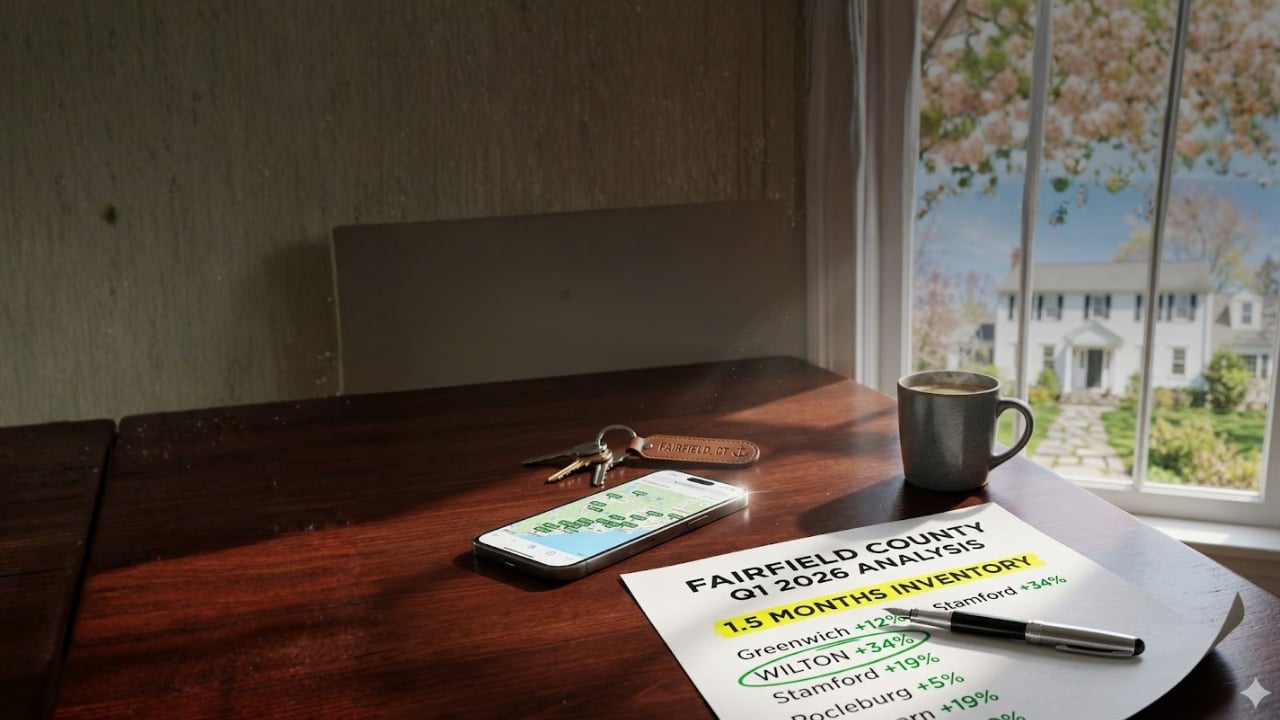
Start with what the multiple listing service actually shows. As of August 2026, Wilton's median sale price stood at $1,345,000. In February 2026, the most recent town-to-town comparison available, New Canaan's median was $2,310,000 and Darien's was $2,350,500. That is roughly a $965,000 to $1,000,000 spread, and it has held steady enough across the year that it is not a fluke of one slow month.
Here is the part that should stop a careful buyer: Wilton is not the smaller, more crowded town in this trio.
| Town | Median Sale Price | Reporting Period | Predominant Residential Zoning | Town Size |
|---|---|---|---|---|
| Wilton | $1,345,000 | August 2026 | Roughly three-quarters of residential land zoned for two-acre-or-larger lots | About 27 square miles |
| New Canaan | $2,310,000 | February 2026 | Zones range from one-third acre to four acres | About 22 square miles |
| Darien | $2,350,500 | February 2026 | Mostly quarter-acre and half-acre lots | About 13 square miles |
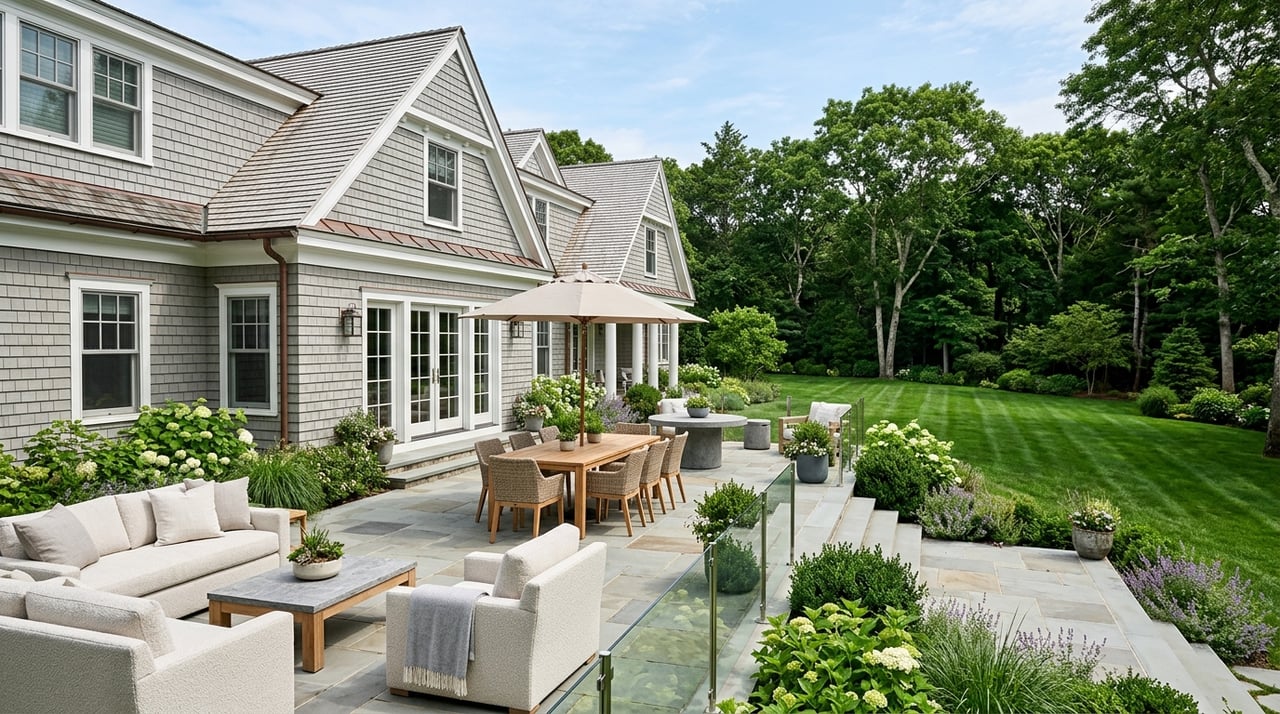
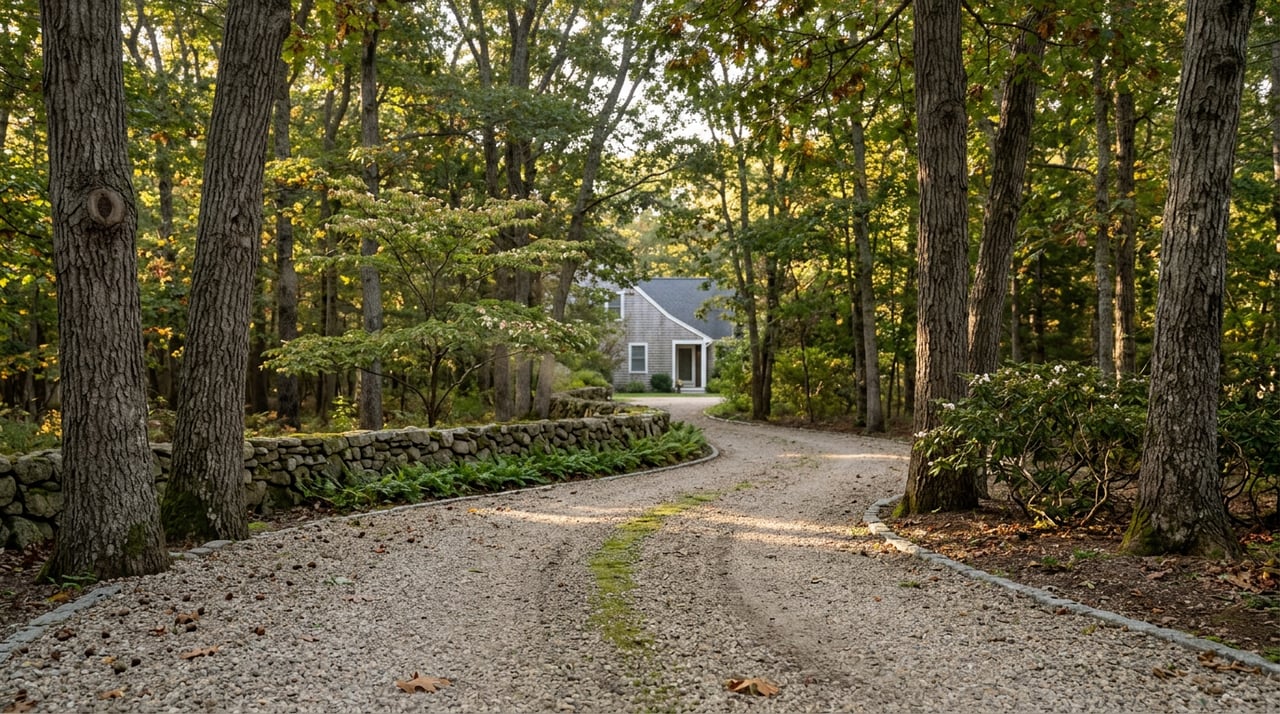
Wilton is the largest of the three towns by land area, has a population in the same general range as its neighbors, and is built around some of the biggest residential lots in lower Fairfield County. It is also, by a wide margin, the cheapest place to buy. That is not a market being generous to buyers. It is a market pricing in something specific, and it is worth naming.
The current activity backs up that this is a live, competitive market rather than a soft one. Wilton homes averaged 27 days on market in July 2026, inventory sat at 2.6 months of supply, and sellers closed at 109.5% of list price with prices up 4.5% over the prior twelve months. Sellers are not waiting around. Buyers are not finding piles of unsold inventory. The discount is not a symptom of weak demand.
What The Schools Don't Explain
The easiest assumption to make is that the price gap reflects a gap in school quality. It does not hold up. Wilton Public Schools enrolled 3,782 students in the 2024-25 year against New Canaan's 4,060 and Darien's 4,673, with a student-teacher ratio of 11.71 to 1 compared with New Canaan's 11.37 and Darien's 10.87. Those numbers are close enough to call comparable. A buyer moving to any of the three towns for the schools is not making a meaningfully different trade in the classroom.
Rule out schools, rule out land, and you are left looking for the actual mechanism. It shows up on the train platform.
The Transfer At South Norwalk
Darien and New Canaan sit on the New Haven Line, Metro-North's mainline into Grand Central, with frequent peak service and a direct run. Wilton does not. Wilton's two stations, Wilton and Cannondale, sit on the Danbury Branch, a spur line that does not connect straight through to Manhattan. Residents on the south end of town also have Merritt 7 as an option, but it runs on the same branch.
Most trains headed into the city from Wilton require a transfer at South Norwalk, where the Danbury Branch meets the New Haven Line. Off-peak service on the branch runs roughly every two hours, a very different rhythm from the every-30-minutes cadence New Haven Line riders in Darien and New Canaan are used to. Total travel time to Grand Central depends on how well the connection lines up, so anyone weighing this trade-off should check the current Metro-North timetable against the specific trains they would actually ride, rather than assume a single number applies every morning.
This is the kind of detail that never shows up in a listing sheet and rarely gets explained until a buyer is deep into a search. It is also, by the math above, doing a lot of the work in that million-dollar gap.
The land is bigger in Wilton. The schools are close enough not to matter. What is actually different is what happens at South Norwalk on a Tuesday morning.
What's Changing, And What Isn't
Connecticut passed a new housing law, HB 8002, in a special legislative session in the fall of 2025. The House approved it 90-56 on November 12, 2025, the Senate followed 20-14 on November 14, 2025, and Governor Ned Lamont signed it into law on November 26, 2025, with most provisions taking effect January 1, 2026. Wilton's state representative, Savet Constantine, voted against it but has continued to work with the town on compliance.
Since July 1, 2026, towns have been required to allow certain transit-oriented middle housing and mixed-use development, subject only to a summary review, on parcels already zoned for commercial or mixed-use purposes. On parcels zoned purely residential, towns may allow the same kind of development but are not required to. The law also lets each town establish up to two Conservation and Traffic Mitigation Districts where road capacity is already strained, and it changes how parking minimums can be applied to larger residential projects.
The Western Connecticut Council of Governments, which is helping Wilton and other member towns comply, has produced preliminary estimates of what this could mean locally: roughly 1,100 new housing units added in Wilton between now and 2050, or about 40 to 50 units a year, with a nearer-term five-year estimate closer to 80 units, or about 16 a year. Those officials have said the numbers may shift as more current development activity is factored in.
Read that correctly and it says two things at once. The direction of travel in Wilton is toward some incremental density, concentrated near commercial corridors like Route 7 rather than spread across the two-acre residential base. And the scale of that change, on the town's own current projections, is measured in dozens of units a year, not a rewrite of the acreage character that defines most of Wilton today. The transfer at South Norwalk is not going away because of this law, and neither is the reason land here is priced the way it is.
What The Discount Actually Buys
None of this makes Wilton a lesser version of its neighbors. It makes it a different trade, and the trade has real substance behind it.
- Weir Farm National Historical Park, a 60-acre property that preserves the home and studio of American Impressionist painter J. Alden Weir, along with the working grounds that inspired his paintings
- Trout Brook Valley Preserve, roughly 300 acres of trails, wetlands, and forest managed by the Aspetuck Land Trust, the largest single piece of Wilton's protected open space
- Merwin Meadows Park, a 27-acre town park on the Norwalk River with athletic fields, swimming, and summer concerts that draw residents from across town
- Additional conservation parcels including the Gregg Preserve, extending a network of protected land that totals more than 1,300 acres townwide
Wilton also never developed around one dominant downtown the way New Canaan grew up around Elm Street or Darien organized itself along the Post Road and the Corbin District. Instead, it is a collection of five distinct historic areas, Wilton Center, Cannondale, Georgetown, Silvermine, and North Wilton, each with its own character, strung along Route 7 and the Norwalk River Valley rather than concentrated in a single walkable core.
Who This Fits
For a buyer who needs to be at a Manhattan desk five mornings a week and wants the shortest, most predictable commute money can buy, that transfer at South Norwalk is a real cost, and Darien or New Canaan may be worth the premium. For a buyer doing hybrid work, commuting a few days rather than five, or simply prioritizing land, privacy, and access to preserved open space over walking distance to a train platform, Wilton's discount is not a compromise. It is the market correctly pricing a trade-off that happens to favor exactly what that buyer wants.
A Few Questions Worth Asking Before You Compare Towns
Does every Wilton train require a transfer to reach Grand Central? Most do, since the Danbury Branch connects to the New Haven Line at South Norwalk rather than running directly into the city. Schedules and connection times vary, so check the current Metro-North timetable against the specific trains you would use before assuming a fixed commute time.
Is Wilton's large-lot zoning likely to change soon? Not dramatically. HB 8002 requires some transit-oriented and mixed-use development on land already zoned commercial, and permits but does not require it on residential parcels. Regional planners' own estimates put Wilton's added housing at roughly 16 to 50 units a year depending on the time horizon, which is incremental growth near existing corridors rather than a shift to the town's residential character as a whole.
If you are weighing Wilton against New Canaan or Darien and want to walk through what your specific commute, budget, and lot preferences actually mean for the search, Linda Dunsmore can help you run the numbers against the towns you're actually considering. Schedule a personalized consultation and get a clear-eyed read on what each town's price gap is really telling you.
This article is general information, not legal, tax or financial advice. Consult a qualified professional about your situation.